Playing Dungeons and Dragons inspires a lot of creativity for me, particularly from a player perspective. You can play a hands-on brawler, a devious thief, a sardonic bard or even an oblivious but well-meaning necromancer; truly, whatever takes your fancy. You can build a deep, emotional backstory for your character and play them as if it really were you reflected in that miniature you bought when you got excited to start the campaign. It’s easy to pass off a DM’s world building as easier than making a character you want to stick with for months, but there are so many ways to go about it that turn it into a complex and rich endeavour.
The Basics
Finding a campaign online, changing a few names and adding some fresh NPCs is a completely acceptable way to DM and has been the tried and true method for many in a pinch. I would argue it’s the way 90% of us got into being a dungeon master to begin with. As a semi-permanent dungeon master, I will admit that I’ve done it more times than I can count. I’ve begun to yearn for long-form campaigns and with that comes a deep dive into world building!
Successful world building can take a good few years of invested time and effort to piece together a cohesive storyline that will keep your players excited, but it doesn’t have to be so difficult or long-winded! There are some key pieces that will help lock a basic world into place and start you on that road to a universe that feels truly your own, and you don’t even need to follow the official D&D content to make this a reality. I’m going to lay out my method for creating a simple and comfy environment for my D&D campaign that will be the groundwork for a more thorough dive!
A side note
Building a unique world and not necessarily being constrained by the “rules” of D&D does come with a healthy side order of understanding consent and comfort levels of your party. As you delve into the unknown with your players, building a rapport of acknowledging their boundaries is crucial to a good campaign. While I actively encourage players to embody their characters and do what they want, that still comes within the limits of what everyone at the table is comfortable with, including you! A very important part of being a dungeon master that took me a few years to learn is that you can say “no” to your party, and you should if discomfort or group dynamics come into question. Remember, you’re building a world for them to play in but that doesn’t mean you should sacrifice your own morals or personal feelings on matters so that they can have fun. You’re playing the game, just as much as they are! I would highly recommend a “D&D consent form”, which I have made myself in the past and handed out to players to fill in to streamline this process.
Let’s get down to business
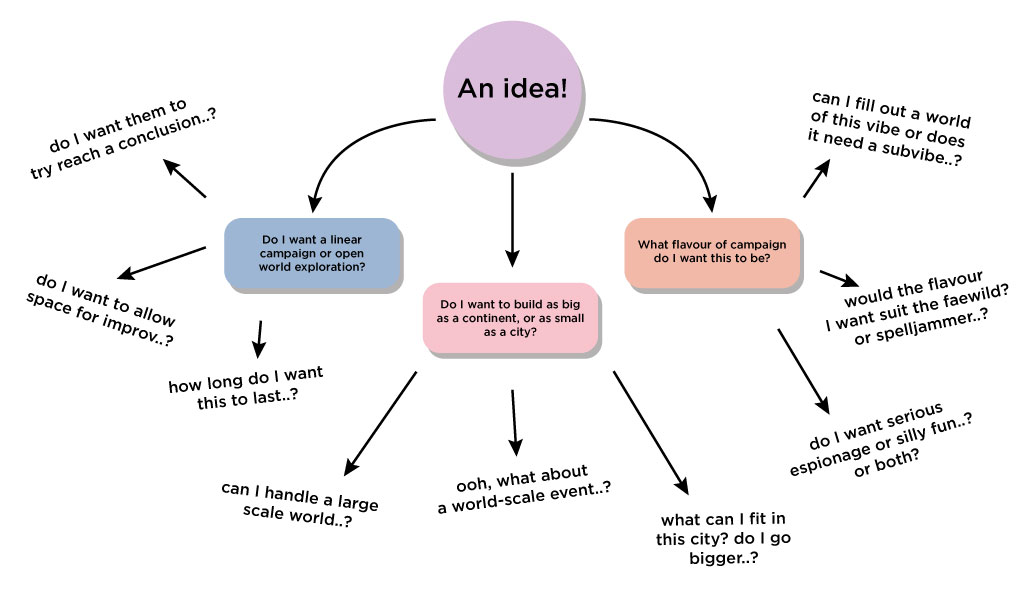
I like to start building my world before I even have players lined up to play. It gives me plenty of time to establish my key points and flesh something out, even if it’s just a storyline. I ask myself three questions to get started:
- Do I want a linear campaign or open world exploration?
- Do I want to build as big as a continent, or as small as a city?
- What flavour of campaign do I want this to be? (More on flavour below!)
Question 1: Having a storyline in mind that you want to explore thoroughly can narrow your games down to a linear campaign with observable direction and guidance during the sessions. This can include having a town of fully boarded up buildings to guide you to your destination directly, or making the “do not enter” areas simply too dangerous for the early game. Alternatively, giving your players multiple options can bring out a truly unique and refreshing open world experience. This question really helps narrow down whether you have a need for multiple lines of interest, like guild halls, mercenary contracts, farming communities or even travelling bands that your players may want to join on the road.
While both options are valuable and have their merits, I personally prefer open world for my campaigns. The small head tilt of confusion that you may do as a DM when your players ask to spend three sessions cornering the milk market is honestly the part of the job that I adore and crave. I want my players to live vicariously through their characters, but it does take a level of awareness of their limitations in the world you’re building. They’re more than welcome to corner the milk market, but they may wake up one day to a protest of disgruntled cattle farmers on their porch the next day. Actions do have consequences and the consequences simply make for fun interactions, combat or just a life lesson to get back on track with the campaign!
A campaign I’m co-running in my partner’s open world universe runs true to this very fact; the story I’ve crafted will eventually reach the end, whether we get to it next session or in ten! Have patience and allow your players to truly embody their characters, as long as it runs in line with the group’s morals and comfort levels. My partner and I like to reference anime and call these “beach episodes”. They’re a gentle deviation from the overarching story to let your players spread their wings and explore who they are as a character.
Question 2: This is where it gets tricky; space is everything, but too much space can cripple you with choices. Deciding on the size of your world comes down to how long you hope for a campaign to last and how much you want to expand the world knowledge of your players. A continent of 2 to 3 countries is about as much as I’ve been able to handle as a DM, and knowing your personal limits of storing all of that knowledge is more of a personal realisation. You could start with a city for your players and fully flesh out that area, then move on to the country at large as your campaign progresses. At the end of the day, take it slow if you have to. There’s no need to panic between sessions if you lay some groundwork before the campaign starts.
Question 3: Now, onto my favourite part; flavour! What I mean by flavour is very simple; The theme, ambience, vibe and overall colours of your world are determined in this step. Some great examples of flavour for a world are whimsical, post-apocalyptic, dark and moody, noir and war-torn! While many different themes and flavours can exist I one campaign, it helps to pin down two or three “vibes” that you want your world to adhere to. Is the world at large currently involved in a continent-wide war, or is the war over and the world feels fresh and new, ready for exploration? If I can establish at least three flavours for my world, it greatly helps map out how I want the world to be perceived by my players.
A world that I created was centred on a small, wheat-producing town called Brewer’s Grove. The people were all friendly and kind, the air was fresh and the sky was clear (whimsy!). However, the underlying gang rings under the town pushed mass production of illegal beers that polymorphed people into sheep, who they would then kidnap for a large corporation that manufactured wool clothing (noir/crime). Two very different vibes and flavours, but one was present from the very start and the other appeared through exploration, investigation and immersion in the world.
After all that, there’s somehow more
These are the initial points I go over as a dungeon master attempting to create a fresh, new world. While this is just the start of what can be a very long process, don’t be discouraged if it starts to seem like a lot! These questions that come after may start to feel overwhelming, but it’s a good thing to break it down into the main three! That way, you can focus on each section at your own pace and not get flustered by the many options available in your head.
I’ve found that players are significantly more excited to jump into a world built in your imagination over running Curse of Strahd for the fifth time, but everyone’s different! Choosing players that you know thrive with role play and discovery turns any campaign into a very unique experience, even if you use an existing campaign book as a base and add your own personal flavour! The world truly is your oyster when it comes to world building, just enjoy the process!